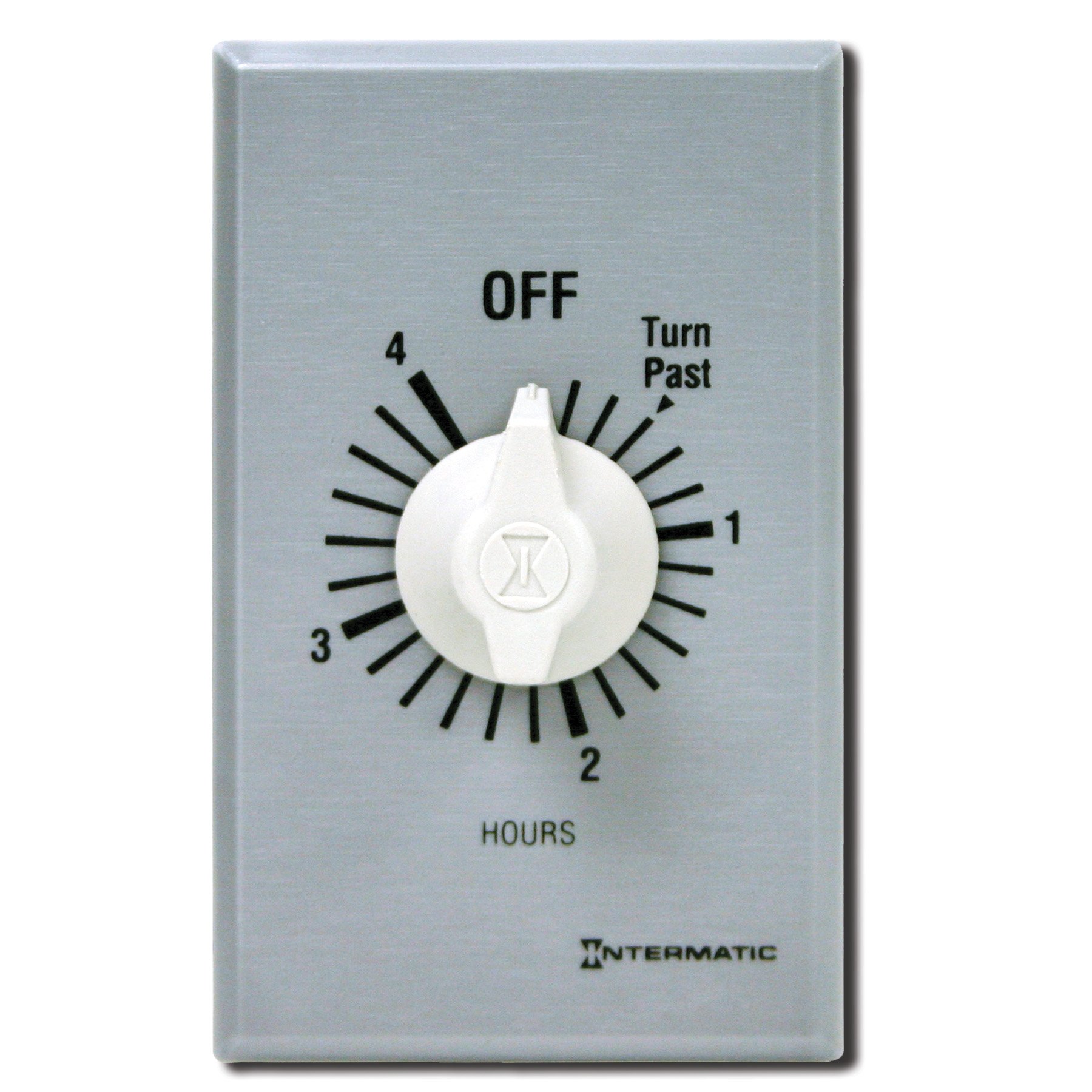
The Intermatic FF4H is a spring-loaded wall timer designed to replace a standard light switch. It offers a straightforward way to automate lights or other devices for a set period, up to four hours. This review looks at its real-world performance, strengths, and limitations for typical household use.
In practice, the timer works by turning a dial to set the desired run time. Once the dial is turned, the connected device—such as a bathroom fan, porch light, or garage heater—stays on for that duration and then automatically shuts off. The brushed metal finish gives it a slightly more polished look than basic white plastic switches, though it still blends into most wall plates without standing out too much. The dial itself has a satisfying, tactile feel when turned, with clear markings for 1, 2, 3, and 4 hours, plus a manual ON position that keeps the device running indefinitely until the dial is turned to OFF.
Key functional features include:
- Spring-loaded mechanical operation: No battery or wiring for memory is needed; the timer uses a spring mechanism that winds as you turn the dial. This means it works even during a power outage, though the set time resets when power is restored.
- 4-hour maximum timer range: The longest single setting is four hours, which is suitable for most short-duration tasks like running a bathroom fan after a shower or keeping a porch light on during a party.
- Single-pole, single-throw (SPST) switching: It controls one load from one location. It is not designed for three-way setups, where a light is controlled from two switches.
- No hold feature: The timer does not have a permanent ON setting that locks the dial; you can set it to ON manually, but it will not hold that position if the dial is bumped. This is a trade-off for the mechanical design.
- Compatibility with most standard wall boxes: It fits into a single-gang box and works with standard incandescent, LED, CFL, and resistive loads up to 15 amps. However, for motors or fans, the rating is lower (typically 1/2 HP).
A notable limitation is the lack of a hold or override function that locks the dial in the ON position. The manual ON setting works, but the dial can be accidentally turned, turning the device off. Also, the timer does not remember the last setting after a power outage—it defaults to OFF, which could be inconvenient if you rely on it for a scheduled task. Another trade-off is the audible ticking sound as the spring unwinds; it is not loud, but in a quiet room, you might hear a faint click every minute as the timer advances.
Compared to digital programmable timers, the FF4H is simpler and more reliable in terms of no programming complexity or battery replacement. Digital timers often offer multiple on/off schedules, random security settings, and longer time ranges (like 7-day programming). However, they can be confusing to set and may require a neutral wire (which older homes may lack). The Intermatic FF4H works without a neutral wire, making it a better choice for retrofit installations where only a hot and load wire are present. The trade-off is that you get only one simple function: turn on for up to 4 hours, then off.
This timer is best suited for people who want a no-fuss, mechanical timer for short-duration tasks—like controlling a bathroom fan, a closet light, or a holiday string light. It is also a good fit for those who dislike programming digital devices or have older wiring without a neutral wire. It is not ideal for situations where you need precise scheduling, multiple on/off cycles per day, or a timer that remembers settings after a power outage. For those needs, a digital timer with battery backup or a smart switch would be more appropriate.
Overall, the Intermatic FF4H does what it promises: it provides a simple, mechanical way to automate a device for up to four hours. It is not a feature-rich device, but its reliability and ease of use make it a practical choice for specific, straightforward applications. Just be aware of its limitations before purchasing.